Risk Management
Risk Management in Trading: The Complete Guide
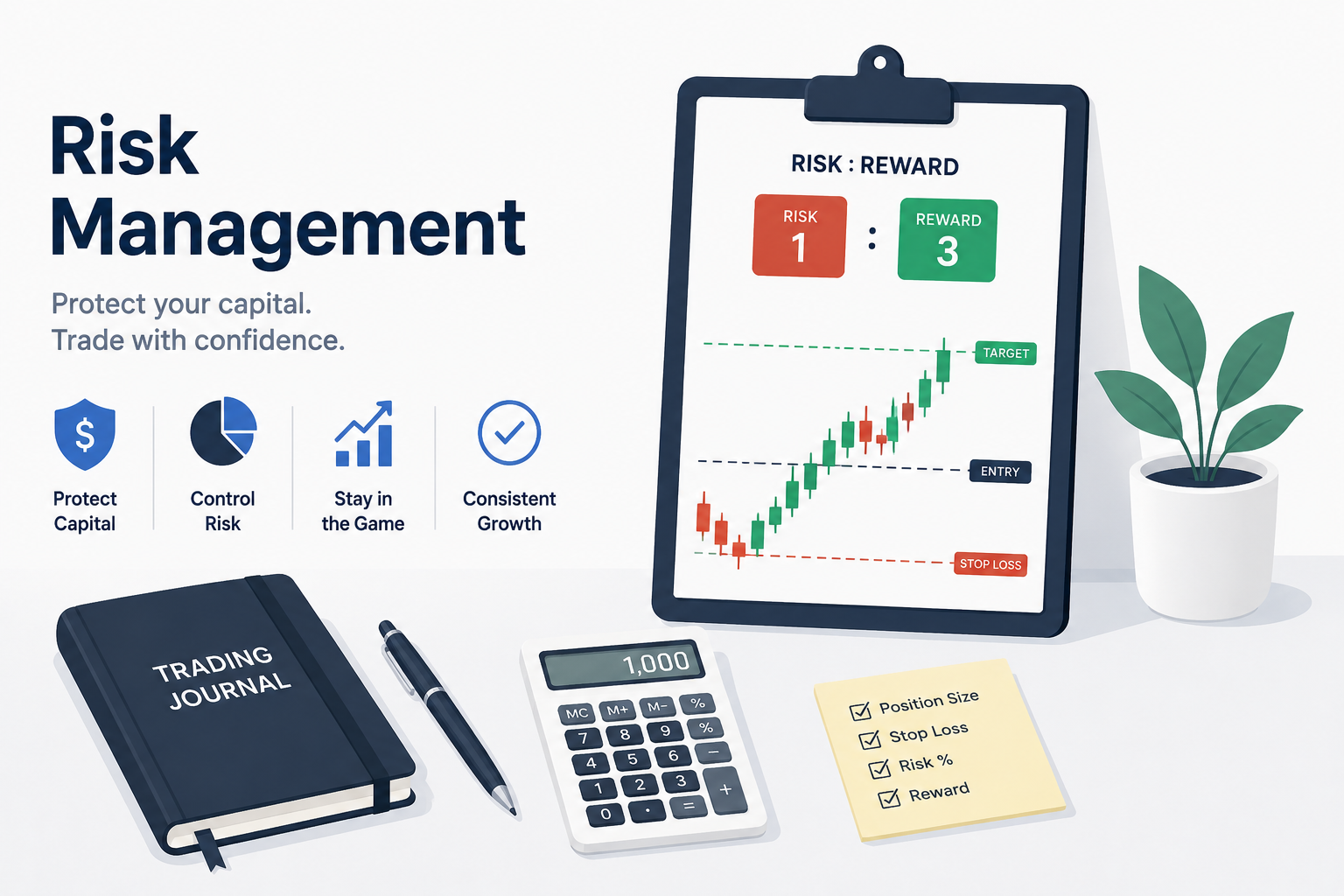
Most traders fail not because they pick the wrong stocks, but because they risk too much on each trade. A single bad trade can wipe out weeks of profits. Risk management is the difference between traders who survive and traders who blow up their accounts.
Professional traders obsess over risk management. They know exactly how much they can lose on any single trade and what percentage of their portfolio they're risking. This discipline protects them during losing streaks and keeps them in the game long enough to profit when their edge plays out.
Why Risk Management Matters More Than Your Strategy
You can have the best trading strategy in the world, but without proper risk management, you'll eventually lose money. Here's why:
- No strategy wins 100% of the time
- Losing streaks happen to everyone
- Large losses are harder to recover from than small ones
- Emotions intensify when real money is at risk
- A single oversized bet can destroy your account
The 1% Rule: Position Sizing Fundamentals
The simplest and most effective risk management rule is this: Never risk more than 1-2% of your total capital on a single trade.
If you have ₹100,000 in your trading account, you should not lose more than ₹1,000-₹2,000 on any single trade. This means calculating your position size based on where your stop loss is set.
Position Sizing Formula
Here's how to calculate the right position size:
| Step | Calculation | Example |
|---|---|---|
| Account Size | Total trading capital | ₹100,000 |
| Risk Per Trade | 1% of account | ₹1,000 |
| Entry Price | Stock purchase price | ₹500 |
| Stop Loss | Exit price if wrong | ₹480 |
| Risk Per Share | Entry - Stop Loss | ₹20 |
| Position Size | Risk ÷ Risk per share | 50 shares |
In this example, buying 50 shares means if your stop loss hits, you lose exactly ₹1,000 (1% of your account). This is proper position sizing.
Stop Losses: Your Insurance Policy
A stop loss is the price at which you exit a losing trade. It's not optional. Every trade needs a predetermined exit point before you enter.
Stop losses protect you from:
- ☑ Holding losing positions too long
- ☑ Hoping a bad trade will recover
- ☑ Emotional decision-making under pressure
- ☑ Catastrophic losses that wipe out your account
Where to Place Stop Losses
Stop loss placement depends on your strategy, but common approaches include:
- Below support levels for long positions
- Above resistance levels for short positions
- Using Average True Range (ATR) for volatility-based stops
- Percentage-based stops (5-10% below entry)
- Technical indicator levels (moving averages, pivot points)
Risk-Reward Ratio: Making Math Work For You
Risk-reward ratio compares how much you stand to lose versus how much you could gain. A 1:3 risk-reward ratio means you risk ₹1,000 to potentially make ₹3,000.
Many swing and position traders aim for minimum 1:2 or 1:3 risk-reward ratios. However, the ideal ratio depends on your trading style. Scalpers may trade with 1:1 or even lower ratios combined with high win rates (70-80%), while position traders might seek 1:4 or higher ratios with lower win rates. What matters is that your win rate and risk-reward ratio work together to create positive expectancy.
| Win Rate | Risk:Reward | Outcome |
|---|---|---|
| 40% | 1:2 | Profitable |
| 33% | 1:3 | Profitable |
| 50% | 1:1 | Break-even |
| 40% | 1:1 | Losing |
With a theoretical 1:3 risk-reward ratio, the mathematical break-even win rate is 25%. However, in real trading, transaction costs (brokerage, taxes, slippage) mean you typically need a win rate closer to 28-30% to actually break even. The exact number depends on your costs per trade.
The consistency you seek is in your mind, not in the markets.
Mark Douglas, Trading in the Zone
Real Trade Example
Let's walk through exactly how to calculate position size for a real trade scenario:
| Component | Details | Calculation |
|---|---|---|
| Account Size | ₹2,00,000 | Total capital available |
| Risk Per Trade | 1% = ₹2,000 | Maximum loss allowed |
| Stock | Reliance Industries | Entry setup identified |
| Entry Price | ₹2,450 | Breakout level |
| Stop Loss | ₹2,400 | Below support level |
| Risk Per Share | ₹50 | ₹2,450 - ₹2,400 |
| Position Size | 40 shares | ₹2,000 ÷ ₹50 |
| Capital Used | ₹98,000 | 40 × ₹2,450 |
| Target Price | ₹2,600 | 1:3 risk-reward ratio |
| Potential Profit | ₹6,000 | 40 × ₹150 per share |
| Risk-Reward | 1:3 | ₹2,000 risked for ₹6,000 gain |
If the stop loss triggers, you lose exactly ₹2,000 (1% of your account). If the target hits, you gain ₹6,000 (3% of your account). Even if you lose 2 trades and win only 1, you're still profitable (₹6,000 - ₹4,000 = ₹2,000 profit). This is the power of proper risk-reward ratios combined with disciplined position sizing.
Why Traders Ignore Their Own Risk Rules
Knowing proper risk management is very different from following it. Understanding position sizing mathematics doesn't prevent you from doubling your position after a winning streak or revenge trading after a loss.
Common psychological traps that break risk discipline:
- Increasing position size after wins (overconfidence bias)
- Moving stops to avoid admitting you're wrong
- Revenge trading after losses (emotional need to "win it back")
- Calculating position size correctly but overriding it because "this trade is different"
- Focusing only on potential profit while ignoring potential loss
These behaviors are psychological rather than technical. As Mark Douglas explains in Trading in the Zone, the mind seeks consistency through familiar patterns, even when those patterns are destructive. This is why reviewing your trades regularly is just as important as calculating your position size correctly—a trading journal helps you identify these patterns before they destroy your account.
When Standard Risk Management Rules Don't Apply
The 1-2% rule works well for directional swing and day trading strategies. However, some approaches require different risk frameworks:
- Options selling strategies often use portfolio-level risk models rather than per-trade limits
- Market making relies on inventory risk and bid-ask spread management
- High-frequency trading uses completely different risk metrics (latency, fill rates, inventory)
- Long-term investing typically focuses on portfolio risk and diversification rather than individual position risk
If you're pursuing these strategies, the principles of capital preservation still apply, but the specific calculations differ. This guide focuses on active directional trading where you're taking positions based on market views. For other strategies, consult resources specific to that approach.
Common Risk Management Mistakes
Avoid these errors that destroy trading accounts:
- Risking more than 2% per trade — One bad streak and you're done
- Trading without stop losses — Hope is not a strategy
- Moving stop losses further away — Turns small losses into big ones
- Revenge trading after losses — Emotional decisions compound losses
- Ignoring position size — Using same size for all trades
- Taking trades with poor risk-reward — Need 60%+ win rate to profit
Practical Risk Management Checklist
Before entering any trade, confirm:
- ☑ Position size calculated based on 1-2% risk
- ☑ Stop loss level identified before entry
- ☑ Risk-reward ratio is at least 1:2
- ☑ Total portfolio risk under 5% (all open trades combined)
- ☑ Strategy and entry criteria met
- ☑ No emotional or revenge trading
Further Reading
To deepen your understanding of risk management and trading psychology, consider these essential books:
- Trading in the Zone by Mark Douglas - Master the mental game of trading
- Trading for a Living by Alexander Elder - Comprehensive trading system including risk management
- Trade Your Way to Financial Freedom by Van K. Tharp - Position sizing and expectancy in depth
- The Psychology of Trading by Brett Steenbarger - Understanding trader behavior patterns